
Coronavirus (COVID-19) Information and Updates
Coronavirus (COVID-19) Information and Updates Menu
Coronavirus (COVID-19) > COVID-19 Vaccine
COVID-19 Vaccination Guidance for Johns Hopkins Medicine Patients
Posted December 9, 2020
Johns Hopkins Medicine is monitoring and assessing all information on the COVID-19 vaccines. We continue to keep the safety of our patients and staff members as our highest priority, and we understand that our patients may have many questions about the vaccines. We will provide information and updates as quickly as we can: Please check this page frequently.
Will Johns Hopkins Medicine distribute the COVID-19 vaccine to patients?
Plans are still being developed to determine if and when Johns Hopkins Medicine will offer a COVID-19 vaccine to patients and the public. We will update this page with more information about our distribution plans as they become available.
Currently, in the United States, there is no approved COVID-19 vaccine. The United States Food and Drug Administration (FDA) is reviewing applications from vaccine developers to see if their vaccines may be distributed under an emergency use authorization. Learn more about the status of the FDA’s review of possible COVID-19 vaccines.
Once a vaccine is authorized for distribution, Johns Hopkins Medicine — like many health organizations across the country — expects to receive an initial quantity of the vaccine. Per guidance from the U.S. Centers for Disease Control and Prevention (CDC), the state of Maryland and DC Health, Johns Hopkins Medicine is directed to distribute its initial quantity of the vaccine to its essential health care employees. This includes medical and non-medical care team members who are essential to providing care and supportive services to patients with COVID-19 and patients with other medical issues.
The state of Maryland, Florida and DC Health will all have initial quantities of the vaccine for distribution. Per the CDC’s guidance, first responders, healthcare personnel and anyone at the highest risk of death or complications from COVID-19, such as people in long-term and assisted nursing facilities, will be given priority.
Learn more about the CDC and vaccination planning.
How is Johns Hopkins Medicine determining who receives the COVID-19 vaccine?
The exact criteria for vaccine prioritization will be determined by the CDC, which has been working closely with state health departments and partners to develop plans for when a vaccine is available. Learn about the CDC’s work group for phased allocation of a COVID-19 vaccine.
People with early access to the vaccine will likely include healthcare personnel, both medical and non-medical care team members who are essential to providing care and supportive services to patients who have COVID-19 and patients with other medical issues.
Johns Hopkins Medicine will follow CDC guidance for providing the vaccine to our health care personnel. In addition, we have developed a priority framework for health care personnel based on guidance from the National Academies of Science, published articles reviewed by experts from the Johns Hopkins Center for Health Security and ethicists and community members. The framework will also be based on our previous experience distributing limited supplies of the swine flue vaccine several years ago.
How Does Johns Hopkins Medicine Decide Which Vaccines to Distribute?
Lisa Maragakis, senior director of Infection Prevention for Johns Hopkins Medicine, explains how decisions will be made on COVID-19 vaccine distribution.
Can I get a COVID-19 vaccine from Johns Hopkins Medicine?
Plans are still being developed to determine if and when Johns Hopkins Medicine will offer a COVID-19 vaccine to patients and the public. Johns Hopkins Medicine is consulting with representatives from the CDC, the state of Maryland and DC Health, as well as ethicists, community members, and patient safety and infectious disease experts to ensure that any COVID-19 vaccine distribution and administration plans are equitable and safe.
Currently, no COVID-19 vaccine has been tested or is available for children or pregnant women. At least one trial including participants between age 12 and 18 with their parents’ permission is in progress. But it may be late 2021 or even 2022 before there is enough evidence on the timing, safety, effectiveness and practical aspects of vaccinating pregnant women or children for the coronavirus, especially children under age 12.
When will I know if I can get a COVID-19 vaccine from Johns Hopkins Medicine?
Johns Hopkins Medicine will contact patients as we learn more about our distribution plans and determine if and when we can begin vaccinating patients. This may include phone calls, emails and MyChart messages to patients. You may also check back on this web page for frequent updates.
Does Johns Hopkins Medicine think a COVID-19 vaccine will be safe?
Yes — from what we know, we believe a COVID-19 vaccine will be safe for the people covered under the initially limited FDA authorization. Here is why:
Our experts have followed developments of the vaccines very closely and we believe that proper procedures are being followed. Review this infographic from the National Institutes of Health (NIH) about how a new vaccine is developed, approved and manufactured.
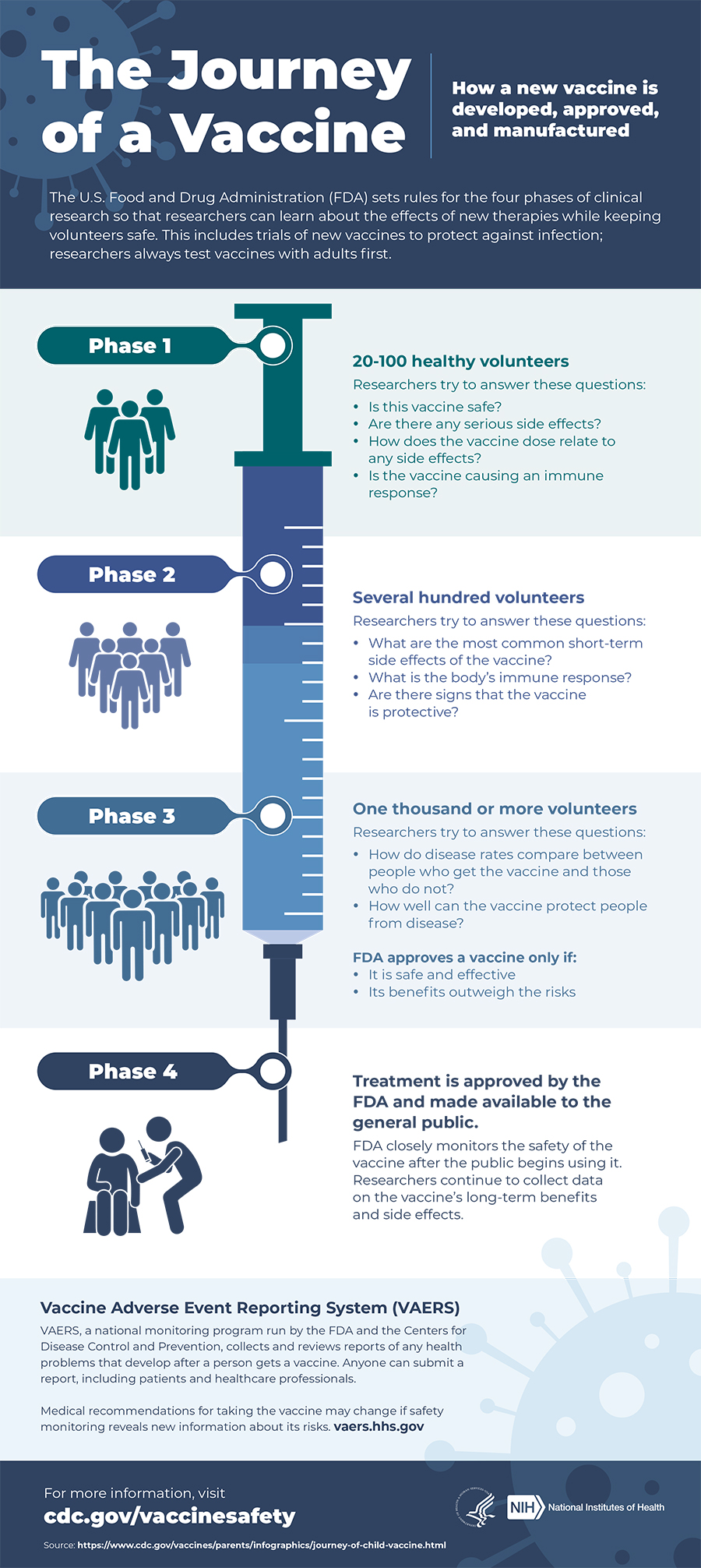
We monitor those who are testing the vaccines and the regulatory agencies that will evaluate the vaccines for authorization or approval. Several points give us confidence that the proper procedures have been followed:
- The FDA has been very clear about the conditions under which it would issue an emergency use authorization (EUA) or full approval for any COVID-19 vaccine candidate intended for public use. The FDA process is well established. Considerations are peer-reviewed by external expert panels. Any attempt to change the process would rapidly come to public attention and be widely publicized. The FDA leadership has reaffirmed its commitment that scientific data will drive its deliberations and any approval decisions.
- Many manufacturers working on the vaccine have pledged to put public safety first and to be transparent in conveying their data to the public.
- The National Academies of Sciences provided guidance on conditions required for appropriate vetting of vaccine candidates.
Learn more general information by reading What You Need to Know about the COVID-19 Vaccine.
Were enough different people tested with these vaccines to be considered safe for everyone?
The clinical trials were designed to include significant numbers (about 25%) of underrepresented minorities, older age groups (about 25%) and people with conditions such as obesity, diabetes and heart and respiratory conditions. The FDA and other reviewers closely consider the populations included in the trials for safety purposes.
Note: The trials did not include pregnant women or children. Trials with these groups are being conducted now.
Are there side effects from a COVID-19 vaccine?
Vaccine developers report side effects that include pain at the injection site, fever, muscle aches, fatigue and headaches, mostly lasting about a day or two. If symptoms persist, you should call your doctor. Recently it appears that patients who are highly allergic, sufficient that they should carry EpiPen, should not get the vaccine at this time.
Does Johns Hopkins Medicine recommend I get a COVID-19 vaccine?
You alone make the decision about whether to get a COVID-19 vaccine. We encourage you to talk to your primary care doctor and review our resources provided here, as well as resources from other health care organizations. At Johns Hopkins Medicine, we will continue to provide science-based, unbiased information so you can make an informed decision.
We will initially offer the vaccine to our health care personnel and others (based on a priority order established by the CDC) if Johns Hopkins experts are satisfied that proper procedures for evaluation and authorization have been followed.
Considering the impact on lives, the large number of hospitalizations and deaths, and high number of people with remaining long-term health issues after they recover from COVID-19, we believe the risks of vaccination are small compared with the large individual and societal benefit of getting the vaccination and preventing cases of COVID-19.